Category: Business

Why Polyurethane Concrete Leveling Is Taking Over Houston’s Repair Market

Houston doesn’t do “gentle” weather. We get soaking rains, baked-dry summers, shifting clay soils, and the kind of temperature swings that quietly bully concrete until it starts dipping at the corners. So when a repair method shows up that’s fast, precise, and doesn’t turn your driveway into a weeklong construction zone… people notice.

Polyurethane concrete leveling has been around long enough to prove itself, but lately it’s been winning jobs that used to default to mudjacking. Not because mudjacking is “bad.” Because foam is usually cleaner, lighter, and easier to control, especially on the finicky slabs you see all over Houston subdivisions.

One line version: it lifts concrete without the mess and without the waiting.

Hot take: Mudjacking feels like yesterday’s fix in a city that settles like Houston

I’m not saying mudjacking can’t work. It can. I’ve seen it hold up fine in the right conditions.

But if you’re dealing with tight tolerances, trip hazards at the sidewalk, a garage lip that needs to meet the slab cleanly, a pool deck where you really don’t want over-lift, polyurethane concrete leveling in Houston, TX is simply easier to steer. You’re not pushing a heavy slurry and hoping it behaves; you’re injecting a material that expands predictably when the crew knows what they’re doing.

And crews like it because the job moves. Homeowners like it because their driveway often isn’t out of commission for days.

How polyurethane leveling actually works (plain-English version, then the nerdy one)
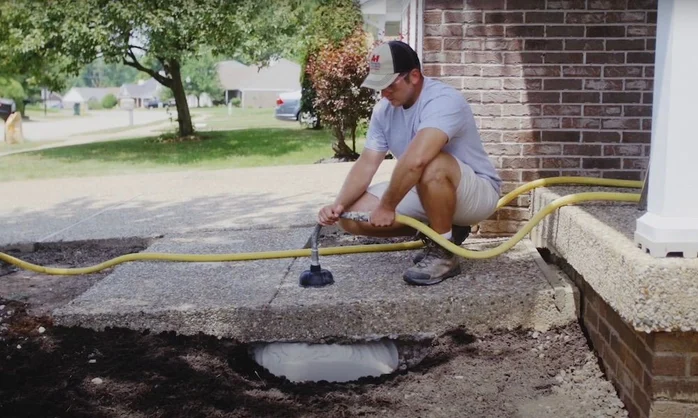
Concrete Leveling

Picture a sunken slab like a table leg that’s lost support. The concrete isn’t “broken,” it’s just unsupported in spots. Polyurethane leveling rebuilds that support from underneath.

What you’ll see on-site:

– Small holes drilled through the slab (usually much smaller than mudjacking ports)

– A hose and injection gun

– The slab rising, slowly, if the tech is careful, back into plane

Now, the more technical angle.

The foam is a two-part polymer that reacts and expands after injection. That expansion does two jobs at once: it fills voids and it creates lift. Skilled techs control lift by adjusting injection location, pressure, and material volume. The goal isn’t just “raise it”; it’s raise it evenly so the load transfers predictably across the base.

Cure time is the part that makes people do a double-take. Many polyurethane systems reach usable strength fast enough that surfaces can reopen the same day, sometimes within hours, depending on site conditions and formulation.

(If you’ve ever had to tell a tenant or customer “you can’t park here until Thursday,” you get why this matters.)

The Houston factor: soil, water, and why voids keep coming back

Here’s the thing about Houston-area settlement: it’s rarely a single-event failure. It’s gradual. Water moves, clay swells, clay shrinks, and the subgrade gets weirdly inconsistent from one season to the next.

Poly foam helps in a few ways that fit our local reality:

It’s lightweight, so you’re not adding a heavy new load to already-sensitive soils.

It can reduce water pathways by filling voids that act like little channels under the slab.

It’s precise, which matters when you’re trying to correct a slope without creating a new drainage problem.

Now, this won’t apply to everyone, but if your slab is settling because of an ongoing drainage issue, downspouts dumping at the edge, negative grade, broken irrigation, you can lift it perfectly and still watch it move again later. Foam isn’t magic. Fix the water.

Polyurethane leveling vs. mudjacking: the comparison people actually care about

You can get lost in marketing talk pretty fast, so I like to keep it grounded in jobsite realities.

Where polyurethane tends to win

Speed: cure and return-to-use can be dramatically faster

Precision: better control of lift and grade correction

Less invasive drilling: smaller ports, typically cleaner finish work

Weight: less added mass under the slab

Where mudjacking still has a place

Mudjacking can be cost-competitive on some projects, and some contractors have decades of experience with it. On larger slabs where ultra-fine precision isn’t the priority, it may pencil out.

But the tradeoff is real: slurry can shrink, wash out, or settle depending on mix and soil conditions, and the process can be harder to fine-tune when you’re trying to hit a clean final elevation.

If you’re choosing for a front walkway trip hazard that needs a clean, safe edge… I lean polyurethane most of the time.

A stat (because feelings aren’t measurements)

The broader concrete repair world has been moving toward polyurethane and resin-based injection because of performance and logistics, not just hype. For a high-level reference point: Grand View Research projects the global polyurethane foam market continuing steady growth through the decade, driven partly by construction uses and performance materials demand. Source: Grand View Research, Polyurethane Foam Market report (latest available edition on their site).

Is that Houston-specific? No.

Does it match what contractors are bidding and installing locally? In my experience, yes.

Fast lifts that stay lifted: what actually matters on install day

Some contractors talk about foam like it’s a single product. It isn’t. Outcomes swing based on choices that never show up in a flyer.

A solid polyurethane leveling job usually hinges on:

Injection strategy.

Hole placement isn’t random. A good tech is thinking about load paths, void geometry, and where lift needs to start versus where it needs to “catch up.”

Moisture and temperature.

Poly chemistry reacts differently when the slab is hot enough to fry an egg (hello, August) versus cool and damp after a rain. Good crews adjust.

Controlled lift cycles.

One big blast of foam is how you crack concrete or overshoot. Staged injection is slower, but it’s safer and cleaner.

Documentation and QA.

I’m biased here, but I trust crews that measure before/after elevations and show you what changed. If a company can’t explain their process beyond “we lift it,” that’s a yellow flag.

 “Okay, but what about safety and disruption?”

On most residential jobs, disruption is minimal. You’re not tearing out the slab. You’re not hauling tons of wet slurry through a gate. You’re drilling, injecting, patching, cleaning up.

That said, polyurethane is still a chemical reaction. Crews should ventilate enclosed areas, control overspray, and handle materials responsibly. If someone shrugs off safety talk, that’s not “tough”, that’s sloppy.

One-line reality check: fast doesn’t mean careless.

Hiring a polyurethane contractor in Houston: what I’d ask if it were my driveway

Some of this is boring, but boring questions save you money.

Pricing transparency (the stuff that bites later)

Ask for an itemized quote. If you get one lump number with no scope detail, you’re basically signing up for surprises.

Questions that tend to reveal the truth:

– What counts as an “extra” (more foam, more holes, mobilization, trip fees)?

– Is the price tied to square footage, number of injection points, or time?

– What happens if the slab needs stabilization beyond the original plan?

Material quality: don’t accept “it’s industrial grade” as an answer

Ask what foam system they use and whether they can provide product data sheets. Compressive strength, density, and water resistance should be measurable characteristics, not vibes.

Also: warranty language matters. If the warranty is vague enough to drive a truck through, it’ll be enforced that way.

Credentials and track record (the unglamorous filter)

Licensing and insurance are table stakes. I also like to hear:

– How many leveling jobs they do per month (not per year)

– Whether the crew is in-house or subcontracted

– If they’ll share references from projects similar to yours

And yes, check reviews, but read the details. “They were nice” isn’t the same as “the slab is still level after two hurricane seasons.”

Real-world impacts: driveways, sidewalks, walkways (where the benefits show up fast)

Trip hazards are the obvious one. The less obvious win is how leveling affects daily use patterns.

A leveled driveway reduces scraping, improves drainage flow, and can keep small separations from turning into bigger breaks. Sidewalk corrections matter for liability too, HOAs and commercial owners in Houston are paying more attention to that now, and they should.

I’ve also seen polyurethane leveling used to “save” slabs that people assumed had to be replaced, especially when the concrete itself was still structurally decent and the problem was underneath.

Where this market is headed in Houston (my read)

More polyurethane. More hybrid approaches. More measurement.

Contractors are already getting sharper with laser levels, mapping, and repeatable QC because customers are asking better questions and because job sites are tighter on time. Regulations and customer preferences are also pushing lower-odor, lower-emission formulations, especially for enclosed or sensitive environments.

The deciding factor won’t be hype. It’ll be whether the industry keeps delivering what the method promises: tight lift control, minimal disruption, and slabs that don’t sink again a year later because someone ignored drainage.

If you want, tell me what kind of slab you’re dealing with (driveway, sidewalk, pool deck, garage approach) and what symptoms you’re seeing (cracks, pooling water, separation, trip edge). I’ll point out what typically causes that in Houston and what questions to ask before you pay anyone.

Custom Metal Bottle Opener Coins Designed For Everyday Convenience

Custom metal bottle opener coins are becoming increasingly popular because they combine usefulness with attractive design. Unlike ordinary promotional items or keepsakes, these multifunctional pieces offer a convenient bottle-opening feature while serving as memorable collectibles. Their compact size, durable construction, and customizable appearance make them suitable for a wide range of personal and professional purposes.

Designed for everyday convenience, custom metal bottle opener coins provide a practical solution that people can carry, display, or collect. Their unique combination of form and function ensures they remain valuable long after they are received.

Why Custom Metal Bottle Opener Coins Are Popular

One of the biggest advantages of custom metal bottle opener coins is their versatility. They can be customized to reflect specific themes, achievements, events, or messages while maintaining a highly functional purpose.

Key benefits include:

  • Compact and easy-to-carry design
  • Durable metal construction for long-term use
  • Customizable shapes, finishes, and artwork
  • Suitable for recognition and commemorative purposes
  • Practical everyday functionality

Because they serve a useful purpose, recipients are more likely to keep and use them regularly, increasing their overall value and appeal.

Designed For Everyday Convenience

Bottle Opener CoinsConvenience is a major reason why custom metal bottle opener coins continue to gain attention. Their lightweight design allows them to fit comfortably in pockets, bags, keychains, or collections. Whenever needed, they provide a quick and reliable way to open bottles without requiring additional tools.

Their practical nature makes them ideal for various situations, including:

  • Outdoor gatherings
  • Family celebrations
  • Corporate events
  • Community activities
  • Personal collections

By combining utility with style, these coins become everyday accessories that offer both function and visual appeal.

Customization Creates Lasting Impressions

Modern manufacturing techniques allow extensive customization options, making every bottle opener coin unique. Detailed engraving, custom artwork, textured surfaces, and specialty finishes can all be incorporated to create a personalized design.

Popular customization features include:

  • Custom logos and graphics
  • Meaningful messages and inscriptions
  • Unique edge styles
  • Decorative finishes
  • Distinctive shapes and layouts

These design possibilities help transform a simple tool into a memorable keepsake that reflects a specific purpose or story. Creative functional keepsakes and collectible designs are showcased at https://www.elitecustomcoins.com/bottle-opener-coins/.

Durable And Built To Last

Custom metal bottle opener coins are valued for their strength and durability. High-quality metal construction helps them maintain their appearance and functionality through regular use. This long-lasting performance makes them suitable for both practical applications and collectible displays.

Their durability also enhances their commemorative value, allowing recipients to preserve memories associated with important events, milestones, and achievements for years to come.

Conclusion

Custom metal bottle opener coins designed for everyday convenience successfully combine practicality, durability, and personalized style. Their ability to function as both a useful tool and a memorable keepsake makes them an appealing choice for a variety of occasions. With customizable designs, reliable performance, and lasting value, these versatile coins continue to offer a positive and meaningful way to create memorable experiences while providing everyday usefulness.

How Flake Graphite Crystallinity Dictates Lubrication Performance in Greases

Flake Graphite
Stop pretending all graphite is the same. If you are buying grease based on price alone, you are likely smearing your expensive machinery with glorified pencil dust. The difference between a grease that protects under extreme pressure and one that fails under a light load comes down to one invisible factor: the crystallinity of the Flake Graphite inside it.
Most engineers know graphite works as a dry lubricant. Few understand that the crystal structure of that flake is the single biggest variable in whether your bearings survive a 500-hour run or seize up at hour 50. Think of it like diamonds versus charcoal. Both are carbon. One will cut glass; the other will crumble in your hand. The same logic applies to flake graphite.

High-crystallinity flake graphite is the gold standard. In this material, the carbon atoms are arranged in near-perfect, parallel layers. These layers slide over one another with almost no resistance. When you pack this into a grease, you get a film that is slippery, durable, and thermally stable. The flakes align themselves under shear stress to create a continuous, low-friction barrier that metal surfaces simply cannot break through.

Low-crystallinity graphite, on the other hand, is a mess. The layers are jumbled, full of defects, and riddled with impurities. When you apply pressure, these flakes do not slide. They grind. They fracture. They turn into abrasive particles that chew up your bearing surfaces. A grease loaded with low-grade graphite is not a lubricant. It is a lapping compound.

Here is where the marketing gets real. Our flake graphite is sourced from deposits with crystallinity ratings above 95 percent. We do not blend in cheap filler to cut costs. We do not accept ore that has been structurally damaged by poor mining practices. The result is a grease that handles extreme pressure without breaking down, resists oxidation at high temperatures, and maintains its lubricity even when the base oil has evaporated.

The proof is in the torque test. In controlled trials, greases formulated with high-crystallinity flake graphite reduced friction by 40 percent compared to standard greases. They also extended regreasing intervals by a factor of three. That is not a minor improvement. That is a direct reduction in downtime, maintenance labor, and grease consumption.

Do not fall for the trap of “graphite is graphite.” It is not. The crystallinity dictates whether your equipment runs smooth or runs hot. If you want a grease that actually performs under pressure, demand the high-crystallinity flake. Your bearings will thank you. Your maintenance budget will thank you. And your competitors will wonder why their machines keep failing while yours keep running.

Efficient Manufacturing Systems Utilize Trusted Pneumatic Component Products

Efficient manufacturing systems rely on dependable equipment that supports smooth operations, consistent output, and long-term productivity. Pneumatic component products play a valuable role in helping industrial processes perform at their best. Their ability to provide reliable motion, accurate control, and efficient energy usage makes them an essential part of modern manufacturing environments.

Supporting Consistent Production Performance

Trusted pneumatic components contribute to stable and dependable production activities by delivering controlled movement and responsive operation.

pneumatic component

Key Benefits Include:

  • Reliable actuation for repetitive tasks
  • Smooth and precise equipment movement
  • Reduced operational interruptions
  • Improved process consistency
  • Enhanced production efficiency
  • Better workflow coordination

These advantages help manufacturing systems maintain high levels of productivity while supporting quality-focused operations.

Improving Equipment Reliability

Durable pneumatic components are designed to perform effectively under demanding operating conditions. Their dependable construction helps equipment operate smoothly over extended periods.

Reliability Advantages:

  • Long service life
  • Consistent operating performance
  • Reduced maintenance requirements
  • Stable pressure control
  • Efficient power transmission
  • Strong resistance to wear

Reliable performance allows production teams to focus on achieving operational goals with confidence.

Enhancing Automation Capabilities

Automation systems benefit significantly from pneumatic products that provide fast response times and accurate control. These features help support advanced manufacturing processes and improve overall efficiency.

Automation Features:

  • Quick and responsive operation
  • Accurate positioning capabilities
  • Smooth integration with automated equipment
  • Consistent cycle performance
  • Flexible application support
  • Improved production flow

These capabilities help manufacturers optimize processes while maintaining excellent operational standards.

Contributing To Workplace Efficiency

Efficient manufacturing systems depend on components that simplify operations and support continuous productivity. Pneumatic products help streamline processes and improve equipment effectiveness.

Efficiency Benefits:

  • Faster production cycles
  • Improved equipment utilization
  • Reduced downtime risks
  • Consistent operational accuracy
  • Enhanced process reliability
  • Better resource management

Organizations that invest in quality pneumatic solutions often experience improved workflow performance and greater operational effectiveness.

Supporting Long-Term Manufacturing Success

Trusted pneumatic components help create dependable manufacturing environments where performance, efficiency, and productivity work together. Their versatility allows them to support a wide range of industrial applications while maintaining consistent results.

Many industry professionals recognize the value of incorporating resources such as https://www.hebaiele.com/es/ when exploring information related to pneumatic technologies and manufacturing solutions. Access to quality component knowledge helps support informed decisions and continuous operational improvement.

Long-Term Advantages:

  • Sustainable equipment performance
  • Improved production quality
  • Enhanced operational confidence
  • Greater system dependability
  • Strong productivity support
  • Positive manufacturing outcomes

By utilizing trusted pneumatic component products, manufacturing systems can achieve efficient operation, reliable performance, and long-lasting productivity. Their contribution to precision, automation, and operational stability makes them an important element in supporting successful manufacturing processes and continued growth.

Employee Advocacy Strategies for Better Engagement

Employee advocacy becomes more impactful when engagement strategies are designed to encourage consistent participation and meaningful interaction. A well-structured approach helps individuals feel more connected to shared communication efforts while improving overall content visibility. Strong engagement ensures that messages are not only shared widely but also resonate effectively with diverse audiences.

Creating Simple and Clear Participation Paths

Engagement improves when employees understand exactly how they can contribute without complexity or confusion. Clear participation methods encourage more frequent involvement.

Effective approaches include:

  • Easy access to shareable content
  • Clear instructions for participation
  • Minimal steps for content sharing
  • Flexible engagement options
  • User-friendly participation flow

When processes are simple, employees are more likely to engage consistently and confidently.

Encouraging Meaningful Content Interaction

Employee Advocacy

Engagement increases when content feels valuable, relevant, and worth sharing. Thoughtfully created content encourages stronger participation and interaction.

Content engagement strategies include:

  • Sharing informative and inspiring updates
  • Providing useful insights and knowledge
  • Highlighting meaningful achievements
  • Offering diverse content formats
  • Ensuring relevance to different interests

Valuable content naturally encourages employees to interact more actively and share with confidence.

Strengthening Recognition and Motivation

Acknowledging participation plays an important role in improving engagement. Recognition builds motivation and encourages continuous involvement.

Motivation-focused strategies include:

  • Appreciating consistent participation
  • Highlighting active contributors
  • Encouraging positive reinforcement among peers
  • Celebrating engagement milestones
  • Reinforcing value of contributions

When participation is acknowledged, individuals feel more connected and motivated to continue engaging.

Promoting Personal Expression in Sharing

Allowing employees to express their Employee advocacy platform  own voice improves authenticity and increases engagement. Personal expression makes advocacy more relatable and natural.

Personalization strategies include:

  • Encouraging individual perspectives
  • Allowing flexible messaging styles
  • Supporting storytelling approaches
  • Promoting authentic communication tone
  • Respecting diverse sharing preferences

This freedom strengthens engagement by making participation feel more meaningful and personal.

Building Collaborative Engagement Culture

A collaborative environment enhances engagement by encouraging teamwork and shared communication efforts. When individuals feel part of a collective effort, participation becomes more active.

Collaboration strategies include:

  • Encouraging group participation
  • Supporting idea sharing among peers
  • Promoting open communication
  • Strengthening teamwork in content sharing
  • Building shared responsibility mindset

Collaboration creates a stronger sense of involvement and increases engagement consistency.

Enhancing Feedback and Continuous Improvement

Engagement improves when feedback is actively encouraged and used to refine participation methods. Continuous improvement helps maintain interest and involvement.

Feedback strategies include:

  • Encouraging open feedback on content
  • Listening to participation experiences
  • Improving based on suggestions
  • Identifying engagement patterns
  • Adapting strategies for better results

This approach ensures that engagement strategies remain effective and evolving.

Sustained employee advocacy engagement leads to stronger communication, wider reach, and more meaningful audience connections. As participation grows, content becomes more dynamic and impactful, creating a continuous cycle of interaction and improvement. Long-term engagement strategies ensure that communication remains active, relevant, and consistently effective, supporting stronger relationships and lasting participation across all advocacy efforts.

Real Estate Agents Provide Trusted Guidance For Successful Property Investment Journeys

Real estate agents play a valuable role in helping individuals and families achieve successful property investment goals. Their market knowledge, communication skills, and strategic guidance create a smoother experience for buyers, sellers, and investors. In today’s competitive property market, trusted real estate professionals help people make confident decisions that support long-term financial growth and stability.

The Importance of Professional Property Guidance

Property investment involves many important steps, from market research to final negotiations. Real estate agents simplify this process by offering reliable information and personalized support. Their expertise helps clients understand property values, neighborhood trends, and future investment potential.

Professional guidance can help investors:

  • Identify high-potential property opportunities
  • Understand changing market conditions
  • Save valuable time during property searches
  • Gain confidence during negotiations
  • Make informed long-term investment decisions

With the right support, property investment becomes more organized, efficient, and rewarding.

Building Confidence Through Market Knowledge

Real Estate Agents

Experienced Makelaar Hoorn understand local market trends and property demand patterns. This knowledge allows them to recommend suitable investment opportunities based on financial goals and lifestyle preferences. Their ability to evaluate property value and future growth potential helps investors reduce uncertainty and increase confidence. Strong communication also improves the investment journey. Real estate professionals explain complex details clearly, making every stage easier to understand. From property inspections to documentation support, they help create a positive and stress-free experience for clients.

Technology and Innovation in Modern Real Estate

Modern real estate services continue to evolve through digital tools and innovative marketing strategies. Virtual property tours, online listings, and digital communication platforms allow investors to explore opportunities more conveniently than ever before.

Today’s real estate professionals often use technology to:

  • Share detailed property insights quickly
  • Improve property search efficiency
  • Provide virtual viewing experiences
  • Analyze market performance accurately
  • Support faster communication with clients

These advancements create greater convenience while helping investors make smarter and more informed choices.

Creating Long-Term Investment Success

Successful property investment is not only about purchasing real estate. It also involves planning for future growth, financial security, and long-term value. Real estate agents support these goals by helping investors evaluate opportunities that align with their objectives.

A trusted professional can assist with:

  • Residential property investments
  • Commercial property opportunities
  • Rental income planning
  • Property resale strategies
  • Long-term portfolio development

Their guidance helps investors stay focused on sustainable growth while reducing unnecessary risks.

Positive Relationships Strengthen Property Journeys

Trust and transparency are essential in every successful real estate experience. Reliable agents build positive relationships through honest communication, consistent support, and dedication to client success. These qualities create stronger confidence throughout the investment process and encourage lasting partnerships. As the real estate market continues to grow, professional guidance remains an important advantage for investors seeking meaningful opportunities. Real estate agents provide valuable support that transforms property investment journeys into positive experiences filled with potential, progress, and lasting success.

Modern environmental remediation services use innovative cleanup technologies.

Modern environmental remediation services are evolving rapidly as innovative cleanup technologies transform how polluted land, water, and air are restored. These advanced approaches focus on efficiency, sustainability, and long-term ecological balance. By combining science-driven methods with digital monitoring and eco-friendly practices, remediation efforts are becoming more precise and effective. Today, the goal is not only to remove contaminants but also to rebuild healthy ecosystems and prevent future environmental damage. As environmental challenges grow, modern remediation strategies provide powerful solutions that support cleaner communities, safer natural habitats, and improved resource management across diverse landscapes worldwide. Readers are advised to see website for updates.

These services are increasingly important in addressing global environmental challenges, including industrial pollution, land degradation, and water contamination. With continuous innovation, they support sustainable development goals and encourage responsible resource use across industries and communities.

Innovative Cleanup Technologies

Modern remediation services utilize a range of innovative technologies designed to target pollutants at their source while minimizing environmental disruption. These methods enhance precision and reduce recovery time.

  • Bioremediation techniques that use natural organisms to break down harmful substances in soil and water.
  • Soil vapor extraction systems that remove volatile contaminants efficiently from underground layers.
  • Advanced filtration and membrane systems that improve water purification processes.
  • Thermal treatment methods that neutralize hazardous materials through controlled heating.
  • Data-driven monitoring tools that track contamination levels in real time for better decision-making.

Key Benefits of Modern Remediation

Environmental Remediation Services

These innovative technologies bring multiple benefits that support sustainable environmental recovery and long-term protection of ecosystems.

  • Improved efficiency in removing contaminants from soil, water, and air.
  • Reduced environmental disruption during cleanup operations.
  • Enhanced accuracy in identifying pollution sources and levels.
  • Long-term cost savings through sustainable and preventive approaches.
  • Stronger protection of biodiversity and natural habitats.

Furthermore, these benefits contribute to stronger regulatory compliance and improved public health outcomes, making remediation an essential part of modern environmental management strategies worldwide.

Applications Across Different Environments

Modern remediation solutions are applied across various environments affected by pollution and degradation, ensuring broad ecological impact.

  • Industrial sites requiring restoration of contaminated soil and groundwater.
  • Urban areas impacted by waste accumulation and air pollution.
  • Agricultural lands affected by chemical residues and soil imbalance.
  • Coastal and marine environments suffering from oil and waste contamination.
  • Former mining areas needing ecological rehabilitation and stability.

Conclusion

Overall, modern environmental remediation services play a crucial role in restoring ecological balance through innovative and sustainable technologies. By integrating advanced scientific methods with environmentally responsible practices, these services help transform degraded areas into healthy, productive ecosystems. The continued development of new technologies ensures faster recovery, greater precision, and long-term environmental protection. As awareness of environmental preservation grows, these modern solutions remain essential for building a cleaner, safer, and more sustainable future for all living systems.

Emerging research and technological advancements continue to refine remediation techniques, making them more adaptive to complex environmental conditions. This ongoing progress ensures that future solutions will be even more efficient, scalable, and environmentally friendly, strengthening global efforts toward ecological restoration.

High-Impact Digital Commerce Solutions Built For Measurable Business Results

Digital commerce has evolved into a powerful ecosystem that enables businesses to create seamless experiences, optimize operations, and generate measurable outcomes. High-impact solutions focus on aligning technology, strategy, and customer expectations to drive sustainable growth and long-term value. These solutions are designed to improve efficiency, enhance engagement, and maximize revenue potential across digital channels.

Key Capabilities

High-impact digital commerce solutions offer a wide range of capabilities that strengthen business performance:

  • Unified customer experience across multiple digital touchpoints
  • Intelligent product discovery and personalized recommendations
  • Seamless checkout processes designed to reduce friction
  • Integrated inventory and order management systems
  • Real-time analytics for informed decision-making
  • Flexible architecture that adapts to evolving business needs
  • Omnichannel engagement synchronization across platforms
  • Enhanced security and trust frameworks ensuring safe transactions

Customer Experience Optimization

Customer experience plays a central role in driving success. These solutions focus on creating intuitive, engaging, and consistent interactions that encourage loyalty and repeat engagement. Many entrepreneurs choose ηλεκτρονικό κατάστημα for launching efficient and attractive online stores that drive business growth.

  • Personalized browsing experiences based on behavior insights
  • Responsive design ensuring accessibility across all devices
  • Fast-loading interfaces that improve user satisfaction
  • Smart search functionality that enhances product discovery
  • Consistent branding and messaging across channels
  • Proactive customer support integration for faster resolution

Data-Driven Growth

Data is a key driver of measurable business results. Advanced analytics and insights empower organizations to make informed decisions and refine strategies continuously.

  • Predictive analytics to anticipate customer needs
  • Performance tracking for campaigns and user journeys
  • Conversion rate optimization through behavioral analysis
  • Segmentation strategies for targeted engagement
  • Continuous improvement based on actionable insights
  • Real-time personalization engines enhancing engagement quality

Operational Efficiency

Efficiency is essential for scalability and profitability. Digital commerce solutions streamline operations and reduce manual effort.

  • Automated workflows for order processing and fulfillment
  • Centralized management of product catalogs
  • Simplified integration with multiple systems
  • Reduced operational costs through automation
  • Improved accuracy in inventory tracking
  • Scalable automation frameworks improving workflow speed

Scalable Architecture

Scalability ensures that businesses can grow without limitations. Flexible systems support expansion and innovation with ease.

  • Modular design enabling easy feature enhancements
  • Cloud-enabled infrastructure for reliable performance
  • Seamless integration with emerging technologies
  • Ability to handle high traffic volumes efficiently
  • Future-ready frameworks supporting continuous innovation
  • Intelligent resource allocation optimizing system efficiency

Measurable Business Outcomes

The ultimate value of digital commerce solutions lies in their ability to deliver measurable results that reflect business success.

  • Increased conversion rates through optimized user journeys
  • Higher customer retention driven by improved engagement
  • Enhanced revenue generation through personalized strategies
  • Reduced operational costs with automation and efficiency
  • Improved decision-making through real-time insights
  • Strengthened business agility through data-backed insights

High-impact digital commerce solutions are essential for businesses aiming to thrive in a competitive environment. By combining advanced technology, customer-focused design, and data-driven strategies, these solutions create meaningful outcomes that support growth and profitability. They empower organizations to deliver superior experiences, streamline operations, and achieve consistent measurable results across all digital channels and long-term sustainable digital growth across evolving customer expectations and performance excellence.

A Practical Guide to Testing Relays from Start to Finish

Relays play a vital role in electrical and automation systems by controlling high-power circuits with low-power signals. Testing relays ensures optimal performance, extends equipment life, and prevents unexpected downtime. This guide provides a comprehensive step-by-step approach to testing relays effectively.

Understanding Relay Components

Before testing, it is essential to understand the key parts of a relay:

  • Coil – Generates a magnetic field to actuate the contacts when energized.
  • Contacts – Switches that open or close circuits, including Normally Open (NO) and Normally Closed (NC) types.
  • Armature – The moving component that connects the coil to the contacts.
  • Spring – Returns the armature to its default position when the coil is de-energized.

Knowing these components helps in identifying potential faults and ensures precise testing.

Preparing for Relay Testing

Proper preparation is crucial for accurate results:

  • Safety First – Ensure the circuit is de-energized to avoid electric shock.
  • Gather Tools – A multimeter, test leads, and a regulated power supply are essential.
  • Inspect Visually – Look for signs of corrosion, burnt contacts, or mechanical damage.

Preparation streamlines the testing process and minimizes errors. Understanding how to test a relay prevents system failures.

Step 1: Testing the Relay Coil

The coil is the heart of a relay. Testing it confirms whether it can generate the required magnetic field:

  • Set Multimeter to Ohms – Measure resistance across coil terminals.
  • Compare Readings – A normal coil shows consistent resistance; infinite or zero resistance indicates a fault.
  • Optional Voltage Test – Energize the coil with rated voltage and listen for a clicking sound, signaling proper operation.

Accurate coil testing ensures the relay will actuate when needed.

Step 2: Checking Relay Contacts

Contacts control the current flow and need thorough inspection:

  • Continuity Test – With the coil de-energized, check NC contacts for continuity. NO contacts should show no continuity.
  • Energize Coil – Apply voltage to the coil and recheck contacts. NO contacts should now show continuity, and NC contacts should open.
  • Inspect Contact Condition – Burnt or pitted contacts reduce efficiency and may require replacement.

Proper contact testing guarantees reliable switching and prevents circuit failures.

Step 3: Functional Relay Testing

A functional test confirms the relay operates under real conditions:

  • Connect to Test Circuit – Apply rated voltage and monitor the relay’s response.
  • Observe Switching Action – Ensure the relay consistently switches without delay or hesitation.
  • Repeat Multiple Cycles – Verify reliability over repeated operations.

Functional testing provides confidence in the relay’s performance under actual working conditions.

Best Practices for Relay Maintenance

  • Regular Inspection – Periodically test relays to detect early signs of wear.
  • Clean Contacts – Remove dust and oxidation to maintain conductivity.
  • Document Results – Maintain a log of test outcomes for future reference.

Consistent maintenance prolongs relay life and enhances system reliability.

Conclusion

Testing relays from start to finish is a straightforward yet essential task. By understanding components, performing coil and contact tests, and verifying functionality, you can ensure relays operate efficiently and safely. Following this guide boosts system reliability, minimizes downtime, and fosters a proactive maintenance culture.

Innovative Mylar Bag Designs Strengthen Packaging Efficiency And Appeal

Innovative Mylar bag designs are reshaping modern packaging by combining durability, visual appeal, and enhanced functional performance. These advanced solutions are widely valued for their ability to preserve product quality while offering improved usability and presentation.

Enhanced Protection and Product Stability

Modern Mylar-based packaging is designed to deliver strong barrier protection against external factors. This ensures that contents remain fresh, secure, and stable over extended periods.

  • High resistance to moisture and humidity
  • Effective barrier against oxygen exposure
  • Protection from light-induced degradation
  • Strong puncture and tear resistance
  • Extended shelf stability for sensitive contents

These features make the packaging suitable for a wide range of applications where preservation is essential.

Improved Design Efficiency and Structure

Innovative design approaches focus on optimizing material usage while maintaining strength and reliability. The result is packaging that is both lightweight and highly functional.

Structural Enhancements

  • Multi-layer construction for added durability
  • Lightweight composition for reduced material usage
  • Heat-sealable edges for secure closure
  • Flexible form factor for easy storage and transport
  • Space-efficient designs that reduce logistics burden

These improvements contribute to overall packaging efficiency and operational simplicity.

Visual Appeal and Branding Flexibility

Modern designs emphasize aesthetics as much as functionality. Eye-catching visuals and customizable surfaces help create a strong product identity and improve shelf presence. Curiosity about what is a mylar leads to discovering its importance in food safety, emergency storage, and industrial packaging systems.

  • High-quality printable surfaces for vibrant graphics
  • Matte and glossy finishes for premium appearance
  • Transparent or semi-transparent viewing options
  • Custom shapes and sizes for unique presentation
  • Enhanced labeling areas for clear product communication

This combination of design flexibility and visual enhancement elevates consumer attraction and engagement.

User-Friendly Features and Convenience

Convenience plays a central role in innovative packaging design. Mylar bags now incorporate features that enhance usability and improve overall experience.

Practical Enhancements

  • Resealable closures for repeated use
  • Easy-tear notches for quick access
  • Stand-up designs for better display and storage
  • Lightweight portability for on-the-go use
  • Smooth sealing mechanisms for added security

These features contribute to both consumer satisfaction and product accessibility.

Sustainability-Oriented Improvements

While maintaining performance, modern designs also support environmentally conscious practices through smarter material usage and efficient production methods.

  • Reduced material waste through optimized cutting techniques
  • Recyclable and reusable packaging components
  • Longer product lifespan reducing unnecessary disposal
  • Efficient sealing that minimizes contamination and spoilage
  • Lighter weight contributing to lower resource consumption

These advancements align packaging innovation with responsible consumption trends.

Expanded Applications Across Industries

The versatility of Mylar bag designs allows them to be used across multiple product categories, offering consistent protection and presentation benefits.

  • Food storage and freshness preservation
  • Nutrient and supplement packaging
  • Pet product containment and protection
  • Cosmetic and personal care storage solutions
  • Small hardware and accessory organization

This adaptability highlights the broad utility of modern packaging solutions.

Future Design Innovations

Ongoing advancements continue to push the boundaries of packaging performance and aesthetics. Future developments are expected to focus on even greater efficiency and consumer convenience.

  • Smarter structural engineering for maximum strength
  • Enhanced barrier layers with thinner materials
  • Improved resealable and tamper-evident features
  • Greater emphasis on minimalist yet functional design
  • Continued evolution of visually striking packaging formats

Innovative Mylar bag designs are significantly strengthening packaging efficiency and appeal by combining protection, usability, and aesthetic excellence. These advancements deliver reliable performance while enhancing user experience and product presentation, ensuring packaging remains both practical and visually compelling across diverse applications.